

Walk 47: Between Holt and Aylsham
Last year I worked out that in the triangle between Holt, Aylsham and Cromer there was one extant church for every 164 souls. Friday's walk was the second of three I had planned in order to make pilgrimage to those of the 27 I hadn't visited during my sabbatical in 2024.
I began the day at St Michael and All Angels, Plumstead, a pretty church in the middle of a pretty village. One of the delights of church-crawling is observing the evidence of the day-to-day life of a parish church and its community. For example, I enjoy discovering passive aggressive notices left by clergy and church officers. There's one in the vestry here which begins, 'Dear Kind Person who feels the need to adjust the settings of the Church lighting.' It goes on to explain - nay, calculate! - how much the 'dusk till dawn' bulb costs to run over the course of year, which, the note concludes, is 'a lot less than a bag of kindling'. Touché!

Heading south out of the village I found myself with an impressive view over a vast expanse of countryside. The only buildings visible in this landscape were the church towers of Saxthorpe and Corpusty, in the valley and on the hill respectively, some three miles away. This aspect cannot have changed very much over the centuries. The familiar call of a buzzard rose to my right. To my left, a farmer was inspecting his potato crop.
I assumed there was only one place of worship in the next village, so I was surprised to stumble upon Little Barningham Mission Hall, a single storey room abutting a house. The sign advertises worship every Sunday afternoon, and declares it to be part of the 'Fellowship for Evangelising Britain's Villages'. A Google search failed to reveal an online presence, and the Fellowship itself was rebranded 'Village Hope' 14 years ago. I'm intrigued to know what happens here on a Sunday afternoon. Naughtily, I have visions of Cousin Amos's 'Quivering Brethren' from Cold Comfort Farm.
Little Barningham is an attractive village, straddling a beck which flows into the Bure at Itteringham. St Andrew, Little Barningham, unlike the Mission Hall, is impossible to miss, standing on a prominent hillock overlooking the village. New timber railings have been installed to help the pilgrim climb the rather steep path up to the church. But it is a very different fruit of carpentry which is the treasure of this. On the back of a box pew (dated 1640) at the front of the nave is a carved skeleton, replete with cloak, hourglass and scythe. One of the two inscriptions underneath reads:
All you that doe this pace pass by
As you are nowe even so was I
Remember death for you must dye
And as I am soe shall you be
Prepare therefore to follow me.
It is, admittedly, not the cheeriest sentiment. Sadly, the original carving was stolen in the 1980s. Its replacement, although obviously not seventeenth century, is very well made.

This church too had a little note, left on the piano, inviting visitors to tinkle the ivories. A tray of sheet music is even provided. So often our churches are full of signs telling people what they should not do. It's refreshing to see something permissive rather than restrictive. In the gospels Jesus is repeatedly invitational. Imagine if we had more signs in our churches which said, 'Please touch this,' or 'Feel free to look round here,' or even 'Come again soon!'
My next footpath took me through oilseed rape, wild and dry, and taller than me. I inquisitively broke off a seed-pod and split it open in my hand. I was surprised at how tiny the seeds were - and amazed that there is oil to be harvested from them. Then my path led through fields of wheat so beautiful I felt like I was in a Shredded Wheat advertisement.
I always assume round towered churches will be small and simple, especially ones seemingly cut off from civilisation. But not so at St Andrew, Wickmere. This is an absolute gem of a building, and one of the few churches which Mortlock - normally so reliable - doesn't really do justice to. The Walpoles of Wolterton Hall adopted St Andrew's when Wolterton's church became ruinous in the seventeenth century. This is one of those churches with lots to see: consecration cross, rood screen, brasses, poppy heads, hatchments, fragments of Elizabethan wall paintings, and two almost identical parish chests. And, as you might expect, there are plenty of good monuments. The tomb chest of the Fifth Earl of Orford, who died in 1931, includes a piece of rock from St Paul's Island in the Pacific, brought back by the midshipman Earl after a shipwreck in 1871. The organ, with its unusually ornate wooden case, once graced Sidney Sussex College's Chapel in Cambridge.
I was surprised to find that most of the fields between Wickmere and Matlaske contained no crops - just acres and acres of grass. I wonder what their purpose is. They are unenclosed, so it can't be for grazing livestock. I was even more surprised, as I approached Matlaske church, to find two people in hazmat suits demolishing an old outbuilding in the neighbouring garden. In their pristine white overalls and large masks they looked like spacemen who had unexpectedly found themselves in a remote Norfolk village. As I ate my lunch in the churchyard - as far as possible from the falling asbestos - I watched a sparrow chase a butterfly through the air. The sparrow took its prey to a telegraph line. The butterfly, however, escaped, allowing me a second viewing of the chase. It may not be as impressive as a great bird of prey catching a small mammal, but it's is still a wonder watching nature do its thing.
St Peter, Matlaske also has a round tower. It's probably a century later than Wickmere's - cleaner, and lacking lumps of carstone. The chancel collapsed in 1726 while the rector was celebrating Holy Communion. According to Mortlock the walls fell outwards and no one was hurt. Which rather begs the question, What happened to the roof? At least they wouldn't have had to worry about asbestos.
My next church lay in the grounds of Barningham Hall. The entrance to Hall's grounds is in the centre of Matlaske. However, there is no footpath south of the hall, so the walker must take the long way round, entering the estate through woodland north-east of the Hall. Here I heard the unmistakable sound of peacocks. Is there another creature whose call is so at odds with its appearance? Peacocks are enchantingly and exotically beautiful, but, to be frank, their cry spooks me out. Perhaps I've watched too many series of The Traitors. This did not prepare me well for my regular bette noir, a path through a field full of cattle. Thankfully they were too far from the path to show any interest in me.
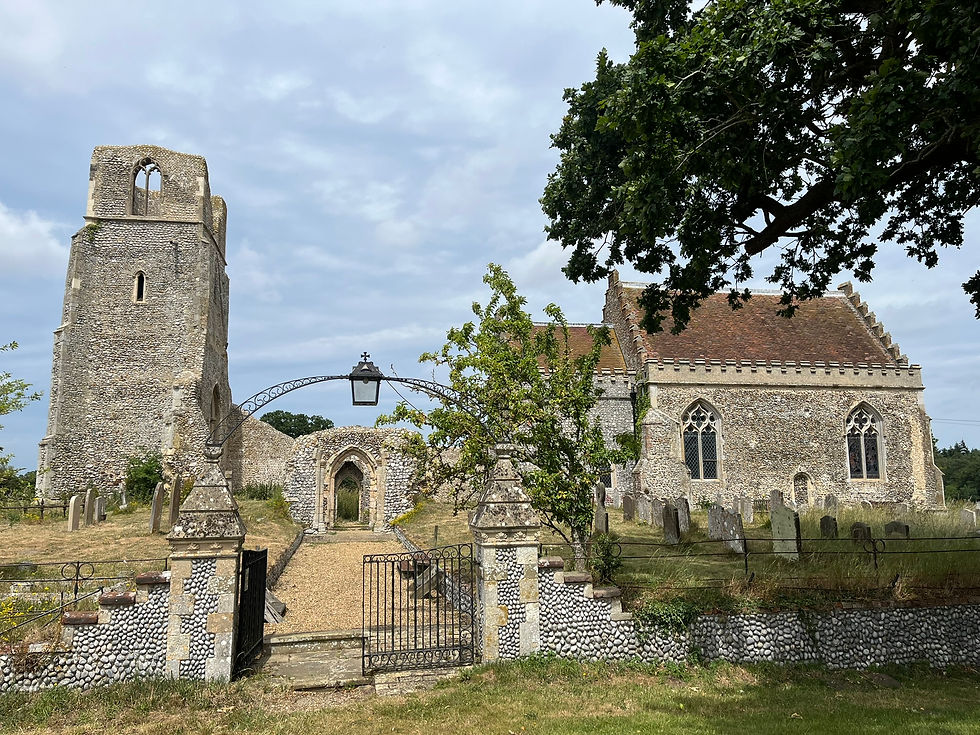
The tower, nave and south porch of St Mary the Virgin, Barningham Winter, fell into ruin over 400 years ago. But the chancel remains as the parish church, with a cute Victorian extension to the west providing vestries on the ground floor and, accessed by an external staircase, a gallery for the staff above. Inside it's rather homely. The electoral roll stands at a whopping 20 - surely a high percentage of the parish. From the fifteenth to the sixteenth centuries the Winter family were lords of the manor, hence there being no Barningham Spring, Summer or Autumn. I imagine Christmas in this church is very special.
I had read in the Matlaske Benefice Magazine - surely one of the most professionally produced parish magazines in Christendom - that a former incumbent had died in May, and that his Requiem Mass (with the full works, no less) had been celebrated here in June. His grave was easy to find, partly because it was freshly filled, but also because a priest is buried the opposite way round to a layperson. I didn't know Fr Michael Cartwright, but standing by his grave I had a deep sense of the faithfulness of rural clergy over the years. It was his wish to be buried here; I can see why.
Having a day full of company on Thursday, this felt like an unusually lonely 9 miles. Apart from two very brief conversations - one with a decorator outside a house, and the other with a man walking his dog - I had not properly engaged with another soul. These villages are so small that the church and, in some cases, the village hall, provide the only places to meet people. I saw not a single walker. In no church did I find a flower arranger, or organist, or jobbing churchwarden, or even a fellow visitor. No one was mowing the grass, or attending a grave. As I returned across the fields to Plumstead, I reflected on how potentially isolating rural life can be.
Sobered by the thought I got into the car to return to my base for the evening, but, realising I needed some human contact, not first without sending a quick message to one of my neighbours. 'Fancy a pint?'


Comments