

Walk 44: Weaving a Way to North Walsham
In my head, Wroxham and North Walsham are in very different parts of Norfolk. One belongs to the Broads, the other to that wonderfully unspoilt part of North Norfolk which is just a bit too far from London to have been gentrified. They are, in fact, only 11 miles apart by foot, which is just 11 minutes on the Bittern railway line.
I started, unorthodoxly, at my pilgrimage’s end, so that I could say Morning Prayer with the clergy of St Nicholas, North Walsham. Fr David Warner is the Vicar here, and was kind enough to give me a tour. It was good to compare notes. We are both new to be being Rural (or, in my case, Area) Deans. His deanery has almost twice the number of churches as mine, whereas I have over three times the number of stipendiary clergy.
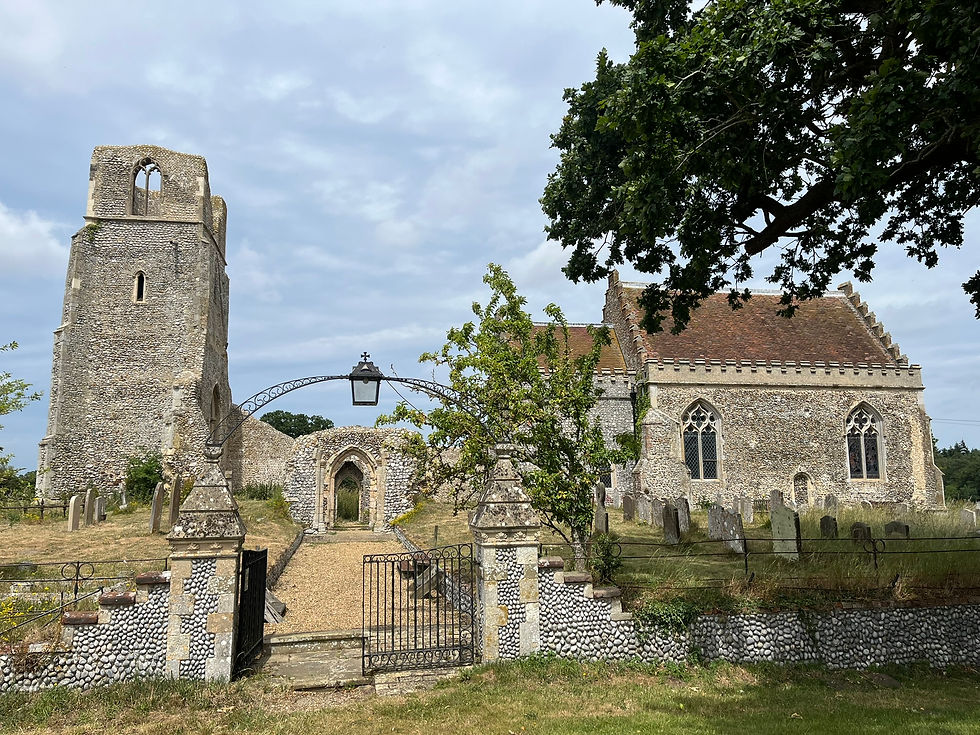
As I have written time and time again, most Norfolk churches have a story about the tower falling down, and, in some cases, being rebuilt. Such is flint. North Walsham’s story is surely the crème de la crème of tumbling towers. It was taller even than Cromer, until a fateful Ascension Day Fayre in 1724, when a combination of some hardcore bellringing and gusty winds caused enough structural movement to bring it crashing down. But North Walsham wears its ruined tower as a badge of honour. Its jagged ruins still reach defiantly to the sky.

Although the church is in the centre of town, it manages to hide behind the high street from which it is accessed by a loke. (Which makes it reminiscent of another market town: Fakenham.) But it’s very well used. People were coming in and out, some to look round, some to pray. Thank God for open churches.
I caught the train to my walk’s start. Fr David had warned me that Worstead Church would close at 3pm, which was reason enough not to explore the churches of Hoveton and Wroxham. They can wait until another time. My route took me briefly alongside the Bure Valley Railway, retracing the final stretch of Walk 33, before heading to the little village of Ashmanaugh. I knew I was back in Norfolk as old boys, tending their gardens or walking their dogs, paused to chat about the weather.
From what was one of Norfolk’s biggest towers to one of its tiniest. Hidden down a dead-end behind some cottages you’d struggle without a map to find the dinky round tower of St Swithin, Ashmanhaugh. There is a special quality to the small churches of Norfolk. Here, as has so often been the case, I found a great sense of peace. In the south corner of the chancel is the tomb of Honor Bacon, who died in 1591 on the morning of her wedding day. The repeated coats of arms feature pigs-a-plenty; the family clearly owned their name.
Criss-crossing the railway by foot, I proceeded north. The area around North Walsham owed its considerable medieval prosperity to the wool trade, and the influx of Flemish weavers. Many of the churches here are products of that wealth, such as St Mary, Tunstead which, even by Norfolk standards, is vastly oversized for its village.

The unique feature of this church is the platform behind the high altar, accessed by steps to the left of the altar. From it you get an incredible view of the church looking west. Under the platform runs a tunnel, accessed by a small door on the other side of the altar. Its purpose is entirely unclear, and various suggestions put forward have been roundly poo-poo-ed. It’s left us a lovely conundrum. There’s also a really good rood screen with well-preserved paintings of the twelve apostles and the four Latin doctors of the church.
I had spotted St Bartholomew, Sloley – its muddled exterior showing its various phases of its construction – from the train. While its seven sacrament font is by no means Norfolk’s grandest, it’s hard to think of one (Gresham, perhaps?) better-preserved. A poignant memorial in the north aisle marks the resting place "of 2 Sons of JOHN & MARY QUAINTRELL both JOHNS Died Infants". The first John died in April 1736. The second John died in July 1737, but clearly the memorial was carved the following year, as the mason has erroneously carved 1738, and has had a go at amending the '8' to a '7'. A second memorial at the other end of the aisle reveals that Mary's misery would continue. Her husband John died a few years later, aged 28, leaving Mary and a daughter Elizabeth.
As I munched my lunch, two cyclists – doing a thirty mile loop from Aylsham – stopped to eat theirs on an adjacent bench. Today truly felt like the first day of spring, and I wasn’t the only one making the most of it.
I had chosen to walk south to north partly because I prefer not to walk into the sun – and, oh my, was its shining glorious today, after two solid months of rain – but also because most churches are better approached from the south. As I savoured the long approach to St Mary, Worstead I was glad of my decision.
The village is synonymous with the wool trade, and the great church is surrounded by medieval weavers’ houses embodying that long-passed prosperity. The village has echoes of Lavenham in Suffolk, and its church is no less impressive. I was welcomed by a parishioner sorting daffodils into bunches to raise money for church funds. A toddler, being pushed around the church by his mother, was joyfully enjoying the generous acoustic.

St Mary’s is all of a piece – late fourteenth century, with a generous clerestory flooding the building with light. The chancel restoration – I guess early- or mid-nineteenth century, and certainly before the effects of the Oxford Movement – is rather austere. But that only serves to draw the eye to the rood screen, which surpasses even Tunstead for detail and condition. There are two other screens, one to the north chapel and another under the tower. By the time I left I had the church to myself, so took my turn to enjoy the acoustic. There’s a particularly good statue of Our Lady of Walsingham, so she was honoured with an Ave Regina caelorum.
The flatlands which surround the Broads were replaced by the undulating landscape of North Norfolk. I joined the Weavers’ Way which took me to Meeting House Hill, a tiny hamlet between Worstead and North Walsham. Ignoring the twentieth century infill, this was presumably a non-conformist settlement grouped around the chapel (built in 1829) – ideally situated in this secluded, wooded location.
There is still a Baptist congregation worshipping here, although it appears they use the hall rather than the chapel. Peering through the windows it has a proper, old-fashioned Protestant set-up: big pulpit in the centre, and a table to the side for the occasional Communion.
I wended my way back to North Walsham. The parish church was closing, but my final destination was a different sort of meeting place. North Walsham boasts two magnets for real ale buffs. The Hop Inn is closed on Mondays, but I enjoyed an excellently-kept pint of Mr Winter’s Quantum Gold at the Peasants’ Tavern.
This was the first Norfolk pilgrimage of 2026. The churches visited, the people met, and even the weather all combined to make it a very, very good one. At Morning Prayer we had prayed in Psalm 26, ‘Lord, I love the house of your habitation and the place where your glory abides.’ All the churches I visited today were indeed houses to love, and where God’s glory abided in abundance.


Comments