

Walk 45: Mostly ruins: Oxborough, Barton Bendish and Beachamwell
Once you are west of Swaffham you are unmistakeably in West Norfolk. The landscape feels more Fens than anything else. Flint begins to give way to Carstone.
That said, neither building material is in much evidence at Oxburgh Hall, one of Norfolk's greatest houses, built (in brick) in the 1480s. The Chapel of St Margaret and Our Lady, built in 1836, is the other side of the moat from the hall. The story of the Bedingfeld family, members of which still occupy part of the hall, gives a fascinating overview of Catholic power, persecution, loyalty and emancipation over the centuries. This little chapel, unremarkable in itself, was built just seven years after the Catholic Emancipation Act, and contains a massive sixteenth century Belgian reredos. It's all very Brideshead.
A note to the church-crawler: Although the chapel is in private ownership, you need to be visiting the hall (a Natural Trust property) and the chapel's opening hours vary. Today it was accessible for only a few hours in the middle of the day; too late to make it my first church, and too early to make it my last. Happily, I had more luck when visiting the hall on a family day out last August.

I planned this walk so that I would accomplish the long church-less stretch, north-east of the hall, first. I'm glad I did. The road out of the village had drains on either side, typical of Fenland, and the long footpaths took me over vast, unpopulated flatlands. For the first four miles of this walk I did not see a single living soul. The farming in this area is predominantly arable; nor were there livestock or horses to keep me company. And, it being early March, the fields were bare. The only sign of life - an accompaniment to the entire walk - was the drone of aircraft from nearby RAF Marham. But this is Lent; a time of entering the wilderness. Walking can, perhaps, be a penance.
As if to prove penance is worthwhile, the village of Barton Bendish - one of my favourite Norfolk place names - was very rewarding. I was immediately met with friendliness. A man in a car stopped, wound his window down, and asked if I needed a lift anywhere. (Politely declined.) Later, I chatted with an elderly dog-walker who told me how he had been an intrepid walker in his youth.
This is one of those Norfolk villages which had multiple manors in the medieval period, and therefore multiple churches. St Mary, Barton Bendish is now in the care of Churches Conservation Trust. The tower and west end collapsed in 1710, and the stunning Norman doorway of the already-ruined All Saints was incorporated into its new west façade. This is one of those special small Norfolk churches - like Frenze and Waterden - which has a timeless, liminal quality because of its intimacy and raw simplicity: plain glass, a mixture of rustic box and open pews (the latter dated 1637), and a lectern fall made out of a pillowcase. The harmonium still works, and there was an ancient Hymns Ancient and Modern propped up on its desk. My prayer here took hymnodic form. I wonder when hymns were last sung in this house of prayer?
St Andrew, Barton Bendish is no more than 400 yards to the east. Is there another pair of Norfolk churches so close together without being in the same churchyard? This is still in use and well cared for. The box pews here are dated 1623, so almost contemporaneous with the pews at St Mary's. But these are anything but rustic: they feature detailed, carved panels and carefully turned finials. Does this demonstrate a social distinction between the two parishes? Or, as I once heard it described, 'a better class of bum'? St Andrew's transpired to be the only church of the day to be spared some sort of building catastrophe.
Onwards and eastwards through the fields, the sun beginning to puncture the clouds. And another village which boasted three medieval parish churches. The ruined tower of St John, Beachamwell, gaunt against the sky, looks from its north side like it might topple at any moment. Two piles of flint from the north wall of the nave remain, looking like massive fingers growing out of the grass. Today they had for company a fleet of tractors tilling the surrounding fields ready for sowing.
St Mary, Beachamwell, sits at the centre of the village, overlooking the expansive village green. Most of the round tower is Saxon, but it's been topped by the most charming Perpendicular octagon, with detailed flushwork alternating with the bell openings. Disaster struck here in 2022 when a spark from some welding equipment set fire to the thatched roof, gutting the entire building. Four years on and there's a new roof, and it appears that restoration to the exterior of the building is complete. It's clear from the faculty notice on the board, and from peering through the fencing and glass-less window, that the next phase is to restore the currently bare interior. I pray in or at every church I visit; here it was for those who are restoring this ancient place of prayer and worship.

In a field to the south of the village are the remains the third church, All Saints, Beachamwell. Three mounds of flint look, from a distance, like Henry Moore sculptures.
The remains of the ruined churches today were getting gradually smaller and smaller. Marked on the map, less than a mile south of Beachamwell, is 'St Mary's Church (site of)'. In the 1960s Pevsner had reported, 'On an artificial mound the scantiest remains of a former parish church.' Simon Knott in the summer of 2006 found nothing, but pledged to return in the winter months when ruins are less likely to be hidden by vegetation. On the mound on this early March afternoon I too could find nothing. But, on the bank of a hollow to the east of the mound there are a few lumps of flintwork earthed into the ground. Perhaps they have fallen here. I took these to be what is left of St Mary, Caldecote. A lost village, and a very almost lost church.
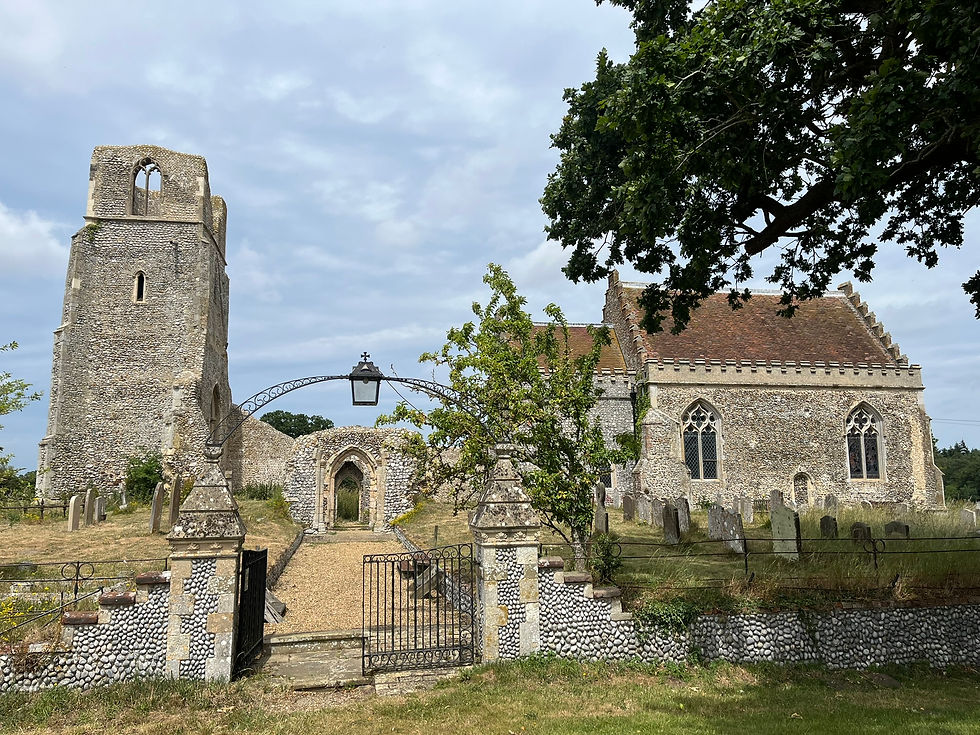
Finally to St John the Evangelist, Oxborough. Like the chapel of the hall, I visited last August. And, again like the chapel, today it was locked. (I had tried in the morning too. I think it is usually open, so this was just bad luck.) In 1948 the tower and spire collapsed eastwards, taking with them most of the nave. Of this nave the south aisle, with the arcade and clerestory, remains. It has the atmosphere of a monastic cloister.
The chancel is now the church, lit by a large Perpendicular east window, and featuring a superb fifteenth century eagle lectern. But the real treasure is to be found in the north chapel: two lavish sixteenth century terracotta tombs. One - belonging to Sir Henry Bedingfeld - forms the divide between the chancel and the chapel. The other - Margaret Bedingfeld's - runs north-south across the chapel incorporating an archway to walk through. The level of detail is incredible. They are exotic, yet they absolutely belong here. The National Trust should encourage every visitor to the hall to visit the church as well. (If it's open.)
This walk comprised three tiny villages either side of the Norwich-Ely diocesan border. It is extraordinary to think that, in the middle ages, between them they had eight churches. So this was a pilgrimage more of ruins and redundancy than anything else. Yet, amongst it all was a cherished church in the centre of a village rising from the ashes. I look forward to revisiting.


Comments