

Walk 46: Rudhams, Harpley and Massinghams
I first visited St Mary, East Rudham, in April 2024, during my sabbatical. I covered the Benefice Eucharist. I was glad to do so, but I came away feeling a bit sad. The Coxford Benefice had been without a parish priest for a couple of years. There were, if I remember correctly, four of us in church, which included the organist and me. It was the Fourth Sunday of Easter, and my first task on arriving in church was to help change the altar frontal from Lenten purple to Paschal white. This in a large-ish pair of villages, with a church school. The future looked a bit bleak.
I remember over coffee afterwards promising to pray for them, and particularly for the appointment of a new priest. Over the course of the rest of my sabbatical I couldn't get the benefice out of my mind, nor, indeed, out of my prayers. I visited it again later that year to walk round the Raynhams and Helhoughton. At this point the Diocese had begun a (fairly low-key) recruitment process, seeking a full-time priest, but on a time-limited basis. The churches I visited and the one or two people I met that day suggested that everything was at a rather low ebb. Hope was in short supply.
I am delighted therefore that things are looking up. There is a new priest in the benefice, working alongside the experienced priest of the neighbouring benefice. There are regular services in, I think, all the churches. And, at least if the social media presence is a reliable indicator, embers are being fanned back into flame. St Mary's is now open every day. It's tidier for one thing. And - like most churches which are open and have regular services - it feels prayed in. So thanks be to God for that.
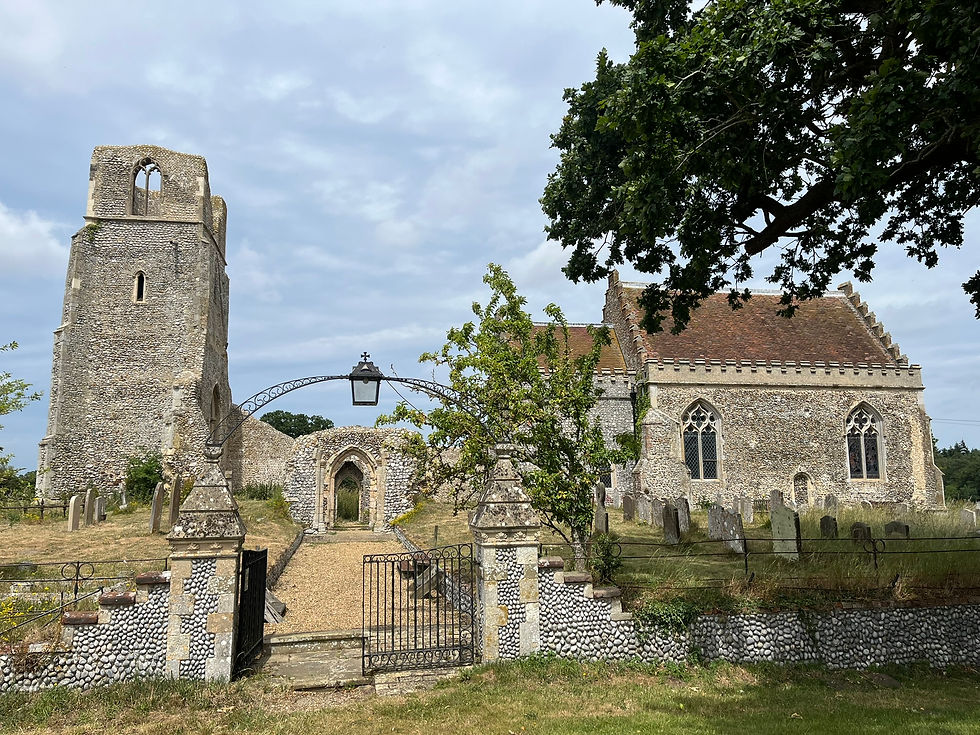
Thursday's walk was in the very good company of my friend James Thomson. James is a long-serving teacher at Gresham's in Holt, and runs the choir which sings Choral Evensong in Hindringham once a month. We made our way down the lane past the school and the village hall to St Peter, West Rudham. This church is in the care of the Norfolk Churches Trust. Even here, where regular services are no longer held, there was a sense of revival: there had been a service the previous Sunday to celebrate the church's patronal festival. Both Rudhams, however, seem to have problems of a structural nature. At East Rudham the inside of the porch is being held up by a timber substructure. Here there are numbers pencilled onto the wall monitoring some pretty serious-looking cracks at the west end of the building. It would appear that the tower is beginning to part company with the nave.
From the Rudhams we crossed the fields, leaving the Coxford Benefice, to St Lawrence, Harpley. This is an architecturally splendid church. The roof has carved angels, unusually (uniquely?) both in the panel running along the central ridge of the roof as well as on the wall plates either side. There is a good collection of poppy-heads, each of which, as the sun moved slowly through the south windows, took their turn to be spotlighted for my photographs. And the huge west window contains some excellent medieval glass in its tracery, including the nine orders of angels; Barton Turf's rood screen rendered in glass.

We paused in the village to look at the charming almshouses, dated 1850. We fell into conversation with one of the residents, who explained that they were founded to house destitute widows and, although now open to both sexes, still keep to their original charitable aims. I feel as though someone must have written a history of English almshouses, and I should like to read it. It strikes me that their constitutions have safeguarded them from centralisation or sale, and so they continue quietly to deliver a largely unnoticed social service in both rural and urban communities.
Footpaths took us west, over the old Kings Lynn to Fakenham railway line, its track-bed still discernible. 24 hours earlier James had been on the North Norfolk Railway, where he volunteers as a driver. He is one of those people who can seemingly turn his hand to anything. He also has a sickeningly encyclopaedic mind. He can name every crop, bird, tree, flower and insect. One of the joys of walking with other people is that they invariably notice things I wouldn't. For example, the rows of stones alongside the fields of potatoes, sifted out by advanced agricultural machinery, but ready to ploughed back into the field for next year's crop. We sat in the shade of a large oak tree to eat our lunch, under the watchful gaze of a circling red kite, our picnics enhanced by a few freshly podded broad beans from the field edge.
On we trekked towards our next stop, but not without James explaining the workings of a water tower. There was an Augustinian priory in Great Massingham from the thirteenth century - one of many in striking distance of Walsingham - although there is no sign of it today. This is a chocolate box village. Sitting alongside the expansive village green is St Mary, Great Massingham. This benefice also has a new priest. I recall the Diocese of Norwich Instagram account announcing his arrival. He and his wife are sheep farmers, and have moved to the benefice with flocks of several different native and historic breeds of sheep. (As well as three small children.) I looked him up when I got home. He has a blog, which explores this intersection between farming and ministry, which I look forward to reading. These are deeply rural communities; there are no significant centres of populatiojn between Fakenham and Kings Lynn. Can there be a better-placed person to shepherd this flock?

Great Massingham is home to one of Norfolk's highly-rated gastropubs, the Dabbling Duck. We paused for a pint - Barsham's 'Oaks' - but reflected that this was not really a pub for weary walkers. Thirst quenched, we bought ice creams from the general stores next to the church, and walked less than a mile along the road to St Andrew, Little Massingham. This is a pretty little church. The Brereton family provided rectors for most of the nineteenth and a good chunk of the twentieth century. Joseph Brereton, Rector from 1867 until 1901, was responsible for the introduction of the railway line we had crossed a couple of hours earlier.
Our route back the Rudhams was mainly on open country lanes with views of open countryside, unimpeded by hedgerows, on either side. At Rudham Grange the public footpath is cut off from the road by farm buildings and the permissive footpath is signposted in only one direction. (Not ours, obviously.) We managed to navigate our way to the footpath, but only to find the path congested with nettles before we reached the little hamlet of Pockthorpe. We beat down what we could with fallen branches, but had to resort to climbing over a fence to get round the blockage. A reminder that this is the worst time of year for little-used footpaths.
This was a long walk on a warm but windy day, done in very good company. I found myself encouraged by the two benefices we visited. Both seem to have begun bright new chapters. For centuries the faith has been proclaimed and Jesus Christ worshipped in these special places, and I will pray that they will flourish in the years to come. James and I repaired to his house for the evening where his son, back from university for the summer, cooked steak on the firepit. He is multi-talented, like his father.


Comments