

Walk 48: Wighton, Wells and Withburga
Is there a more evocative time of the year than early November? Or a time when there is such synergy between meteorological and liturgical seasons? North Norfolk wore a Remembrance-tide shroud of thick fog this morning. Having fulfilled Remembrance Sunday duties in the parish yesterday, the memory of the fallen hung in my thoughts and prayers as I wended my way through villages which would have felt the pain of loss no less than North London suburbia.
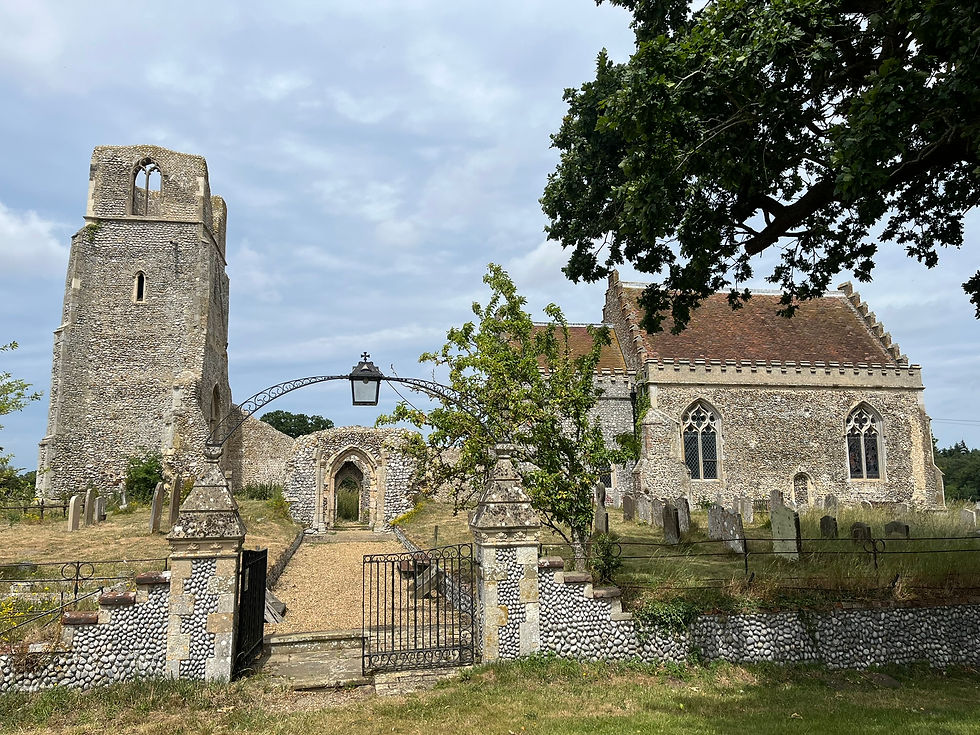
All Saints, Wighton rises slightly above its village, and its little tower – more of which later – does not prepare the visitor of the scale of the interior. The nave can be confidently dated to the 1410s, and the chancel just some thirty years later. Mortlock and Pevsner make comparisons with Great Walsingham up the road. Wighton feels bigger (but is that simply because it still has its chancel?) but doesn’t have quite the same sense of homeliness of Great Walsingham.

The outpouring of grief and the desire to commemorate the war dead benefitted the Catholic Revival in the Church of England. That revival left its mark on Wighton, which is another indication of its proximity to Walsingham. The high altar was ‘given in thanksgiving for the deliverance of our country from the peril of invasion and victory’ in the Second World War. Incidentally, it’s nice to see not one but two ‘English altars’ preserved in this church, complete with riddels and their posts. Most have been messed around with to enable westward-facing celebrations of the Eucharist.
It had been a couple of decades since I last visited this church, but I hadn’t forgotten the story of Wighton's tower. It blew down in a storm in the 1960s. But, ten years later, along came Leeds Richardson, a wealthy Canadian industrialist. While researching his family tree, he discovered ancestors in Wighton, and out came the cheque book. He rebuilt the tower in 1976 and, for good measure, popped in a new ring of bells. How often have I – and doubtless countless other clergy – prayed for a Leeds Richardson to find forebears in my parish!
In the churchyard I found a simple cross inscribed ‘PEACE’. In fragile and uncertain times, it felt like a good prayer to make before I began my walk, passing the village war memorial and crossing the Wells and Walsingham Light Railway.
Making a pilgrimage in foggy conditions is not so bad. Fog, like snow, has a way of dampening sound. And the lack of visibility made for a surprisingly prayerful ascetic. From the top of Gallow Hill I could see hardly anything. But, as I descended towards the outskirts of Wells the mist began to lift.
St Nicholas, Wells-next-the-Sea, sits on the southern edge of the town, surrounded by cottages which once housed fishermen and their families, and are now largely self-catering holiday homes with eye watering prices. The church doesn't really feel 'next-the-Sea' until you walk to the end of Beach Road to the Lifeboat Station. From there you can see how this tower would have guided - and still does guide - sailors to harbour.

I remember visiting this church as a child with my father, and being very taken with the statue of St Nicholas, patron saint of seafarers. He stands, hand raised in blessing, on a vessel which is counter-levered from a nave pillar. Today I learnt that this image was carved by Anton Wagner, who is also responsible for St Michael slaying the dragon at the west end of the north aisle. Reading the blurb provided by the then vicar, Bill Sayer (who still lives locally), I realised that it must have still been very new when I first encountered it. It looks to have suffered from an infestation of woodworm since then. This church received a substantial amount of lottery funding leading to a large-scale restoration over the last few years. I hope they’ve treated their patron saint to some of the bounty.
The Roman Catholic parish has a similarly nautical dedication: Our Lady, Star of the Sea. Its west façade is in the style of a Dutch gable – a nice bit of architectural assimilation – and, like its Anglican counterpart, is open during the day. I love this title for Our Lady, not least as it begins in the exquisitely beautiful office hymn Ave maris stella. I sang its first verse its first verse here:
Hail, O star that pointest
towards the port of heaven ;
thou to whom as maiden
God for Son was given
Holkham Hall, the seat of the Earl of Leicester, needs little introduction. I entered through its unassuming east gate. I have visited the estate many times, but never had I seen it in such breathtaking beauty as today. To the south, the mist hung low in the air, backlit by the autumn sun. At regular intervals, V-shaped flocks of Holkham’s famous pink-footed geese graced the blue-ish sky. In the summer the picnic area is usually a sea of young families. Today I ate my lunch surrounded by fallow deer not 25 feet from my table.
Most people associate Holkham with the Cokes. Thomas, 1st Earl of Leicester, is credited with the innovation of crop rotation in the late eighteenth century. Lady Glenconner, daughter of the 5th Earl and lady-in-waiting to Princess Margaret, is now a prolific nonagenarian author. But long, long before aristocracy made their home at Holkham, St Withburga is said to have lived as a young hermit here.
I visited her well at on Walk 29 in 2024. At the heart of Withburga's story is that, in the seventh century, she founded a religious community in what is now Dereham. Construction was postponed when the builders could no longer continue for lack of hydration. Withburga prayed to Our Lady, who sent tame does whose milk quenched the builders’ thirst. Hence the settlement became known as Dereham. Walking through Holkham’s grounds nearly 1,400 years later, it is very easy to imagine her as no stranger to tame deer.
A Saxon church was built here in her honour, and the present St Withburga, Holkham – heavily restored in the nineteenth century by Juliana, Countess of Leicester, wife of the 2nd Earl – is the only church in the world dedicated to the saint. She is portrayed in bench ends on the choir stalls, a church in her hand and a doe at her feet.

According to the memorial on the north wall, nineteen men from Holkham gave their lives for King and Country in the First World War, and two in the Second World War. Cokes are listed among them. But the name which caught my eye was that of Christmas Bell. Holkham does Christmas (the season) in a big way. Indeed, Channel 4 managed to make a whole documentary about it. But who knew that our freedom was paid for by a young man bearing that name. I can only imagine he was born on 25 December, and his parents didn't like the name Noel, As I left the church, I noticed a wreath of poppies laid against an otherwise unremarkable gravestone. It was Christmas’s. 'We will remember them.'
The church lies on the opposite side of the lake from the hall. I rounded the lake to the Victoria Inn, on the coast road. Despite recently advocating for slower returns from pilgrimages, I caught the bus – with its superb views from the top deck across Holkham’s marshes – back to Wighton. My day was not yet done…
Since my sabbatical, and as a result of this blog, I have been in occasional correspondence with Catherine Temple. She and her husband, Stephen, are responsible for Mrs Temple’s Cheese, famous throughout the county and beyond. They are based at Copys Green Farm in Wighton. I love Mrs Temple’s Cheese; indeed a table groaned under the weight of it at our wedding reception in neighbouring Binham a decade ago. So the opportunity to meet her was akin to Charlie visiting the Chocolate Factory.
Quite apart from the deliciousness of their cheese (a staggering 34 tons of which is produced each year), Catherine and Stephen are pioneers of renewable energy. Dairy farmers get a bad press from environmentalists, but at Copys Green an anaerobic digester converts cow manure into energy. The sitting room of their seventeenth century farmhouse was positively sultry. Such is their innovation, they are now beginning to supply electricity to Wighton and surrounding villages. And, perhaps best of all, Catherine is a champion of pilgrimage and was a regular attendee of the Revd James Shelton's pilgrimages in the south of the county before his move to Durham.
Restored by tea (Malawian tea, in fact – this is another part of Catherine’s story) and excellent conversation I met some of her very friendly Brown Swiss herd. The fog had begun its descent as I left. By the time I was back at my base, a mere 4 miles away, it had entirely enveloped the Norfolk countryside.
As I said Evening Prayer, I couldn’t help but invoke St Nicholas and Our Lady, Star of the Sea for those on the waters this evening, and, in these days between Remembrance Sunday and Armistice Day, for those navigating their way through the perilous waters of conflict. One of the beauties of pilgrimage is that it allows us to escape from the vicissitudes of our lives and the 24/7, anxiety-inducing bombardement of news, while at the same time providing space to offer all those things up in prayer. 'Stella Maris, lead them and us through the fog.'


Comments