

Walk 49: West of Reepham
Updated: Nov 11
Death was on my mind as I began my walk this morning. I realise that sounds rather morbid, but it isn’t meant to be. Clergy, I suspect, spend more time contemplating death than the average person. And most/some/all of the time we do so ‘in sure and certain hope of the resurrection to eternal life’. So, when you think about it like that, it’s all rather positive.
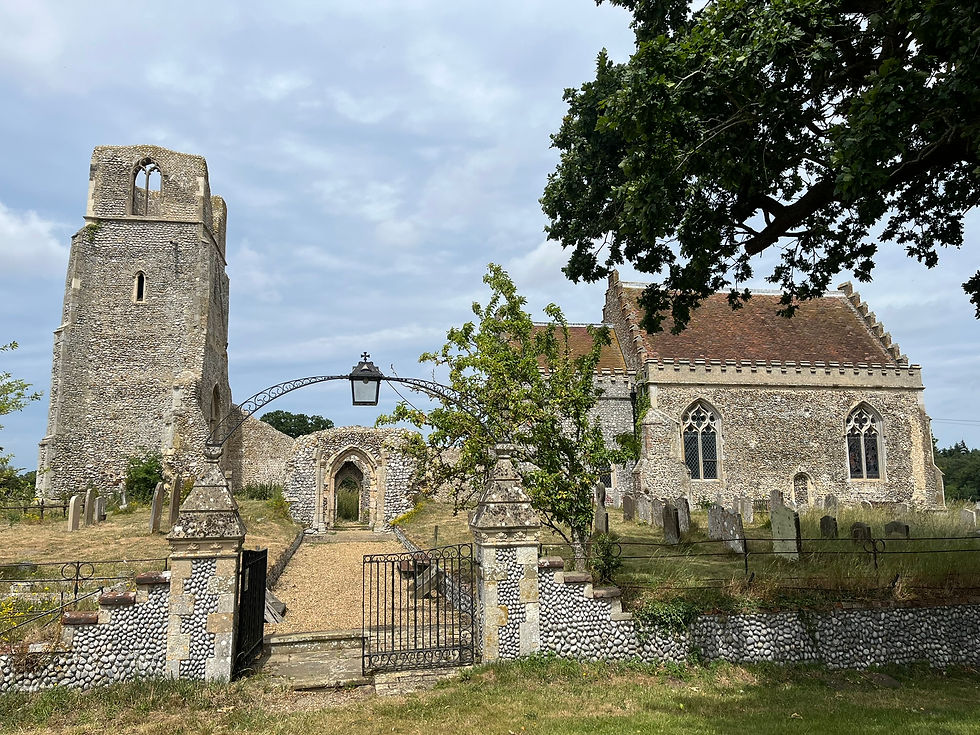
Today took me to the A1067 between Fakenham and Norwich. I was looking forward to St Swithin, Bintree because of its association with the Revd Richard Enraght, the last Church of England priest to be imprisoned for ritualism. The ‘offences’ were not committed in this quiet Norfolk village, but earlier in Enraght’s ministry when he served in a parish in Birmingham. He was imprisoned in 1880 for numerous high church practices, the most newsworthy of which was the use of individual wafers at Holy Communion. One witness for the prosecution was Enraght’s own churchwarden, who presented himself for Holy Communion only to take the consecrated host from the church as a piece of evidence.
Fr Enraght, released and exonerated, finished his ministry in Bintree. And, sadly, ministry seems to have all but finished here. The church has been entrusted to the Diocesan Churches Trust, a body which acts as a custodian of church buildings which can no longer sustain regular worship. This is an innovation of the Diocese of Norwich, with the intention of saving churches from redundancy.
The church is kept locked. There are a couple of broken window panes in the tower, and two of windows at the east end are netted. When churches are locked, I find myself being more attentive to churchyards. Against the east wall of this church is a grave with a metal marker next to it, which reads: ‘Probably [my italics] the grave cover of Richard de Langbrigg, Priest, Rector, 1216-1270. R.I.P.’ I wonder exactly what the probability is! I wish I had been more attentive to this churchyard; I didn’t realise until I got home that Fr Enraght was buried just a few feet away.
Thousands of people must drive past St Nicholas, Twyford on the A1067 without knowing it’s there. I only became aware of it last year when it was clad in scaffolding. In February 2021 a tree was uprooted, causing significant damage to the porch-cum-tower and bellcote. Works to repair the church took place in 2025.

Twyford is a tiny village, all of which is separated from the equally tiny church and (unequally large) hall by the main road. The list of benefice services in the noticeboard was dated June 2025, so it was no surprise to find this church locked too. I wouldn’t expect anyone to take their lives into their hands crossing that road twice a day to lock and unlock.
There was another more serious sadness here. A more up-to-date notice attached to the porch door, announced the death of the Rector, the Revd Sally Kimmis, in September. I prayed for her – for a joyful resurrection – before beginning the next stretch of my walk. (It is only this evening, re-reading the notice which I had photographed on my phone, that I realised it included the telephone numbers of not one but four keyholders. So perhaps I could have got in after all. Next time!)
The tower of Holy Innocents, Foulsham beckoned me over the fields through the long grass. Foulsham was a pleasant surprise. Its characterful buildings are grouped around a small market place; it feels like a miniature Reepham. There is nothing small about the church. And, best of all, the doors were wide open! A coffee morning was just finishing up and the church is open daily.
RAF Foulsham was an important base in the Second World War, and this visceral connection to conflict in living memory means that the village takes Remembrance very seriously. A net of embroidered poppies bedecked the west door. Inside the church are displays commemorating 100th Group Bomber Command, which had a base here. Individual embroidered poppies bear the names of those from the village lost in both world wars. This year the village school had got involved, Flags hanging from the pillars were accompanied by acrostic poems written by the children. The ladies clearing up after coffee proudly told me that three children had even attended the service in church and read.

Foulsham’s churchyard spreads extensively east of the church. Whereas yesterday I ate my lunch surrounded by fallow deer, today I did so surrounded by graves. ‘In the midst of life we are in death.’ Cranmer incorporated these words into his Funeral Sentences, and those words rang true for me today.
I had observed at Bintree and Twyford what felt like the imminent death of the church in these villages. (Except, of course, The Church never dies, even if buildings and communities come and go.) And I had observed the markers of human death too: faithful clergy from many centuries ago to the present; the fallen of the world wars; and the countless tombstones which stand in our churchyards, their inscriptions gradually fading with age and decay.
As I walked back to Bintree I reflected that none of this should leave us feeling fearful or anxious. Just in the last 10 days in my parish church in London we’ve kept All Saints’ Day and All Souls’ Day, laid to rest a cherished parishioner, and observed Remembrance Sunday. In all these celebrations – and they are, every one of them, a celebration – we have renewed our hope in Christ’s victory over death. Yes, ‘in the midst of life we are in death.’ But, in those same Funeral Sentences we are reminded, ‘I am the resurrection and the life, saith the Lord: he that believeth in me, though he were dead, yet shall he live: and whosoever liveth and believeth in me shall never die.’
As I wandered back through Bintree I caught sight of the minutes of the meeting of the parish council on the village noticeboard. They are looking for ways to use St Swithin’s Church: a Christmas carol concert in December, a fete in the summer. Perhaps these too are little resurrections, signs of life. Now is not the time to despair; indeed, it never is.


Comments